Borrelia recurrentis - Classification, Morphology, Habitat, Culture, Antigen, Virulence factors
Introduction of Borrelia recurrentis
Borrelia recurrentis is the causative agent of relapsing fever and is transmitted via soft-shelled ticks. As it is an invasive bacterium, it enters the skin and causes disease.
Classification of Borrelia recurrentis
The classification of Borrelia recurrentis is:
Domain: Bacteria
Phylum: Spirochaetota
Class: Spirochaetia
Order: Spirochaetales
Family: Borreliaceae
Genus: Borrelia
Species: recurrentis
Morphology of Borrelia recurrentis
MOrphologically, Borrelia recurrentis is a gram-negative spirochete having unequal, loose 5-10 spiral coils with one or both pointed ends. It measures 8-20 μm x 0.2-0.4 μm and has 15-20 endofalgella per cell.
The bacteria are stained by Giemsa stain for microscopy and exhibit cork-screw-like motility and are seen as actively motile in fresh blood preparations.
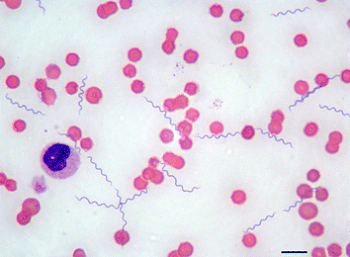
Fig: microscopy of Borrelia recurrentis (Source: Wikipedia)
Habitat of Borrelia recurrentis
Borrelia recurrentis habitats the bloodstream, spleen, liver, lungs, kidneys, and bone marrow of an infected person suffering from relapsing fever.
Culture of Borrelia recurrentis
Borrelia recurrentis is microaerophilic and requires 28-30°C as the optimum temperature. It requires complex nutritional requirements, thus it is difficult to grow on an artificial medium.
Borrelia recurrentis can be cultured in the chorioallantoic membrane (CAM) of the chick embryos, and intraperitoneal inoculation in lab animals. They appear early in the blood, and in the brain for a longer time.
Cell wall components, Antigenic structure of Borrelia recurrentis
Antigen variation is a unique property of Borrelia recurrentis. DNA rearrangement in linear plasmid present in Borrelia is responsible for Antigenic variation and causing relapse.
Virulence factors of Borrelia recurrentis
Antigenic shift or Ag variation is responsible for periodic febrile and afebrile stages observed in the relapsing fever (outer membrane protein differs). B. recurrentis can escape from the immune clearance of the host which is one of the most important virulence factors of Borrelia recurrentis.

.jpg)






.jpg)
.jpg)