Borrelia recurrentis - Clinical manifestation, Relapsing fever, Jarisch-Herxheimer reaction
Clinical manifestation of Borrelia recurrentis
The major clinical manifestations of Borrelia recurrentis are relapsing fever, Jarisch-Herxheimer reaction.
Relapsing fever, Jarisch-Herxheimer reaction
The clinical manifestations of epidemic louse-borne and endemic tick-borne relapsing fever are essentially similar. The incubation period of 2-15 days and the patients have an abrupt onset of fever, headache, and myalgia that lasts 4-10 days.
Petechiae, diffuse abdominal tenderness, conjunctival effusion, splenomegaly, and hepatomegaly are the associated symptoms of Borrelia recurrentis infection. These symptoms correspond to the bacteremia phase of the disease. In 3-7 days, organisms are cleared from circulation as the host produces specific Ab in response to the agent.
The afrabile period lasts for 4-7 days. The Borrelia recurrentis becomes sequestered (hidden) in different organs during this period. Subsequently, organisms re-emerge in blood with newly modified Ag and multiply in another febrile period. About 3-10 relapses occur with more relapses in untreated cases while subsequent relapses are usually milder and of shorter duration.
Louse-borne relapsing fever, caused by Borrelia recurrentis, is more severe than tick-borne relapsing fever.
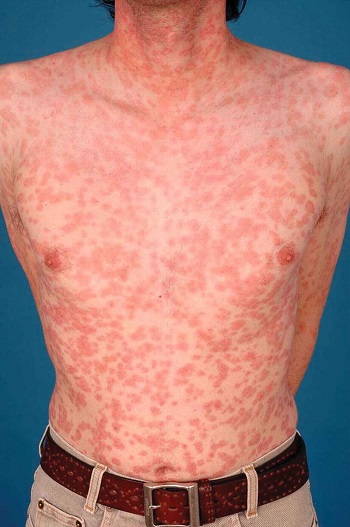
Jarisch-Herxheimer reaction
Treatment of relapsing fever, caused by Borrelia recurrentis, with antibodies may result in the formation of Jarisch-Herxheimer reaction.
This reaction is associated with the clearance of microorganisms from the bloodstream and the release of cytokines within hours of treatment. The patient may experience tachycardia, chills, rigors, hypotension, fever, and diaphoresis. This reaction may also result in death.
Acute respiratory distress syndrome is also associated with tickborne relapsing fever.
.jpg)



.jpg)
.jpg)