Filovirus - Replication, Transmission, Host Immunity
Replication of Filovirus
Replication of filovirus begins with attachment to the cell membrane by its surface GP. The virus is then taken up by a process known as macropinocytosis.
*macropinocytosis = the process in which the eukaryotic host cell form macropinosomes which are a segment of plasmid membranes that extend out from the cell in order to incorporate the virus into the cell
The cellular proteases cathepsin B and cathepsin Lcleave GP32. This allows GP and host protein Niemann-Pick C1 (NPC1) to interact, which is a prerequisite for the fusion of viral and endosomal membranes. Host endosomal calcium channels called two-pore channels play a crucial part in the endosomal trafficking of incoming viral particles to the site of fusion.
GP mediates the fusion of the viral and endosomal membrane, releasing the viral ribonucleocapsid into the cytoplasm where the negative-strand RNA genomes undergo transcription and replication. The RNA synthesis reactions require NP, VP35, and L.
For initiation of transcription, EBOV also requires VP30. Translation of viral proteins occurs and new filovirus particles are assembled at the plasma membrane. VP40 function as the viral matrix protein and directs the budding of particles from the cell surface. GP, a type I transmembrane protein, is incorporated into the budding particles, as are viral nucleocapsids containing the viral genome.
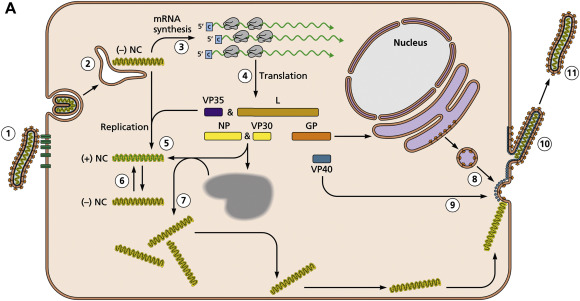
Fig: filovirus replication (Source: Sciencedirect)
Transmission of Filovirus
Transmission of filovirus occurs on contact with infected monkey tissue/human tissue, direct contact with blood, bodily secretions, saliva, stool, semen, breast milk, tears, nasal and skin swabs, etc (in case of EBOV).
The reservoir has not been definitively identified though many African fruit bat species are considered natural reservoirs. Monkeys taken as a food source have served as routes of infection but are not considered reservoirs.
Host Immunity of Filovirus
Host immunity of filovirus, as an effective IFN response is the most useful mechanism to control filovirus replication. Production of IFN-α in the early stages is associated with survival. Unfortunately, IFN response is usually suppressed resulting in the inability to control infection.
For EBOV, VP35 and VP24 function as IFN antagonists while for MARV, VP35 and VP40 function as IFN antagonists.
.jpg)

.jpg)


.jpg)