Arenavirus - Replication, Pathogenesis, Epidemiology, Transmission, Lab Diagnosis
Replication of Arenavirus
Arenavirus attaches to host receptors through glycoprotein and is endocytosed into vesicles in the host cell. Fusion of the virus membrane with the vesicle membrane, ribonucleocapsid releases the virions in the cytoplasm.
Sequential transcription and viral mRNAs are capped in the host cytoplasm and replication presumably starts when enough nucleoprotein is present to encapsidate neo-synthetized genomes and antigenones.
The ribonucleocapside interacts with Z protein under the plasma membrane and buds, releasing the virion.
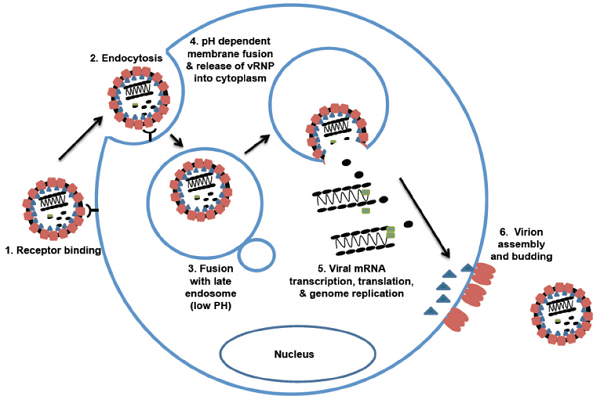
Fig: Arenavirus replication (Source: ResearchGate)
Pathogenesis of Arenavirus
Arenavirus primarily infects macrophages and causes vascular damage. T-cell-induced immunopathogenic effect contributes to the exacerbation of tissue destruction
Epidemiology of Arenavirus
Arenavirus infections are zootic and two rodent families Muridae and Cricetidae are reservoirs. Fruit bats are known to contain the Tacaribe virus (an Arenavirus) and rodent-to-rodent transmission may be horizontal or vertical.
Transmission of Arenavirus
Arenavirus in humans occurs by inhalation/ingestion of particles contaminated with the urine or saliva of infected animals. The viral infection may also occur from bites (direct route; but rare), open wounds, and ingestion of infected rodents.
Lab-acquired and nosocomial transmission can also occur. Human-to-human transmission occurs after the transplantation of infected tissues and is fatal.
Lab diagnosis of Arenavirus
Lab workers are at great risk of Arenavirus infection so biosafety level 4 agents, category A is required
Specimen
The specimen collected for Arenavirus diagnosis is
blood
CSF
throat swab
urine
biopsy/autopsy tissue
breast milk
Culture/isolation
The Arenavirus can be isolated in:
Cell culture (BHK-21, VeroE6, or Vero 76 cells) is used for isolation.
Lab animals (suckling mice, guinea pigs, hamsters) can be used for viral isolation with limited success.
Serodiagnosis
Ab detection by ELISA detects specific IgMAb in acute sera as well as IgG Ab in convalescent serum samples
Indirect fluorescent Ab tests in serum and CSF can also be done to detect IgM
Antigen capture ELISA detects Ag in blood and tissue for early diagnosis
Immunohistochemistry can be done. But is rarely done due to the infectious nature of the virus
Molecular diagnosis
RT-PCR diagnoses viral RNA
Treatment of Arenavirus
Ribavirin (a broad spectrum nucleoside analogue antiviral) is a drug of choice to treat Arenavirus infection.
Prevention, Control of Arenavirus
Arenavirus can be prevented and/or controlled by
No vaccines
Control of rodents can reduce the infection


.jpg)



.jpg)