Bunyavirus - Morphology, Classification, Antigen
Classification of Bunyavirus
Classification of Bunyavirus is done by:
Realm: Riboviria
Kingdom: Orthornavirae
Phylum: Negarnaviricota
Subphylum: Polyploviricotina
Class: Ellioviricetes
Order: Bunyavirales
This order Bunyavirales contains 477 virus species which are grouped into 12 families.
Cruliviridae - includes crustacean infecting bunyaviruses
Fimoviridae - infect plants
Leishbunyaviridae - infects protozoans
Mypoviridae
Phasmaviridae
Tospoviridae - infects insects of Thysanoptera order
Wupedeviridae
Medically important families in this order include:
Arenaviridae - Lassa fever, Argentine hemorrhagic fever
Hantaviridae - Hantavirus
Nairoviridae - Crimean–Congo hemorrhagic fever
Peribunyaviridae - California encephalitis virus, Jamestown Canyon virus, La Crosse encephalitis virus, Oropouche orthobunyavirus, Bwamba Fever
Phenuiviridae - Rift Valley fever
Introduction of Bunyavirus
Bunyaviruses are vector-borne viruses. With the exception of Arenaviruses and Hantaviruses, all viruses in the Bunyaviridae family are transmitted by arthropods (mosquitoes, ticks, or sandflies). Meanwhile, Hantaviruses are transmitted through contact with clear mice feces.
Incidence of infection is closely linked to vector activity for example. Mosquito-borne viruses are more common in the summer.
Human infections with certain Bunyavirus, such as the Crimean-Congo Hemorrhagic fever virus are associated with high levels of morbidity and mortality, consequently handling of these viruses must occur with a Biosafety 4 laboratory.
They are also the cause of severe fever with thrombocytopenia syndrome. Hantavirus or Hantavirus hemorrhagic fever, common in Korea, Scandinavia, Russia, and Western North America is associated with high fever, lung edema, and pulmonary failure.
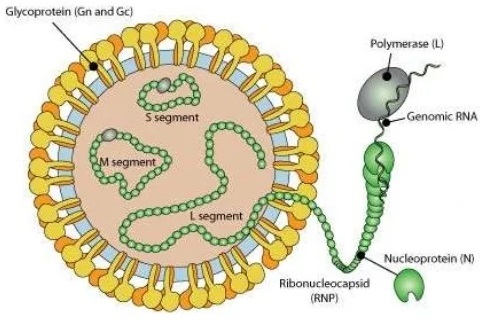
Fig: Bunyavirus morphology (Source: viralzone.expasy.org)
Morphology of Bunyavirus
Morphologically, bunyaviruses are spherical, enveloped particles 90-100 nm in diameter. They contain single-stranded RNA, which, with the nucleoprotein, forms three nucleocapsid segments. The segments are large, medium, and small helical, circular structures.
The RNA has a total molecular weight of 5x10⁶. The nucleocapsid is surrounded by a lipid-containing envelope. Surface spikes are composed of two glycoproteins that confer properties of neutralization of infectivity and hemagglutination of RBC
Bunyaviridae have a tripartite genome consisting of a large (L), medium (M), and small (s) RNA segment. These RNA segments are -ve ss and exist in a helical formation within the virion
The L segment encodes the RNA-dependent RNA polymerase, necessary for viral RNA replication and mRNA synthesis
The M segment encodes the viral glycoproteins, which project from the viral surface and aid the virus in attaching to and entering the host cell
The S segment encodes the nucleocapsid protein (N)
The L and M segment is a negative sense. For the Genera of Phlebovirus, the S segment is ambisense. Ambisense means that some of the genes on the RNS strand are negative sense and others are positive sense.
The S segment codes for the viral nucleoprotein (N) in the negative sense and a nonstructural (Nss) protein in ambisense.
Classification and Antigen types of family Bunyaviridae
The family Bunyaviridae includes 4 genera containing 35 serogroups with at least 304 viruses of which 51 in the four genera are known to cause human disease
Genus: Hantavirus; type species: Hantaan virus
Genus: Nairovirus; type species: Crimean-Congo hemorrhagic fever virus
Genus: Bunyavirus; type species: Bunyanwera virus
Genus: Phlebavirus; type species: Rift Valley Fever virus
.jpg)


.jpg)