Category: parasitology
Total: 46 articles found.
Strongyloides stercoralis
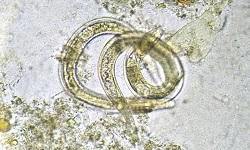
Strongyloides stercoralis
The female Strongyloides stercoralis parasite habitats the mucosa of the small intestine – especially the duodenum and upper jejunum.
Trichuris trichiura

Trichuris trichiura
The name whipworm is derived from its characteristic ship-like shape i.e. it resembles a whip with wider “handles” at its posterior end.
Trichinella spiralis
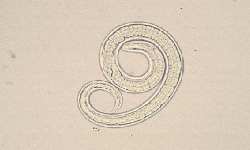
Trichinella spiralis
The parasite is typically present in undercooked pork products and must not be confused with pork tapeworm- which is distantly related.
Clonorchis sinensis
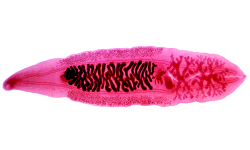
Clonorchis sinensis
Clonorchis sinensis is the causative agent of clonorchiasis, feeds on bile, and is one of the most important liver fluke infecting humans.
Paragonimus westermani
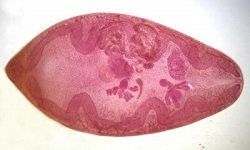
Paragonimus westermani
The important morphological features of Paragonimus westermani include adult worms, eggs, and the infective form metacercaria.
Fasciolopsis buski
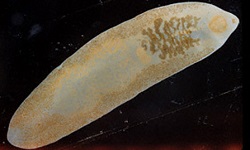
Fasciolopsis buski
Fasciolopsis buski is the most common human intestinal trematode causing infection in man.
Fasciola hepatica
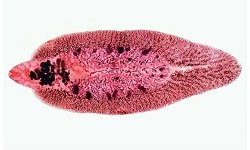
Fasciola hepatica
The large liver fluke primarily infects the liver of the sheep while humans are the accidental hosts.
Schistosoma japonicum
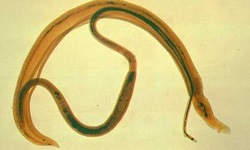
Schistosoma japonicum
The Schistosoma japonicum habitats the mesenteric venules of the small intestine and the rectal (haemorrhoidal) plexus of veins.
Schistosoma mansoni
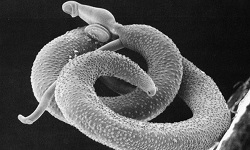
Schistosoma mansoni
Both male and female Schistosoma mansoni are found together in the mesenteric venules which drain the large intestine and posterior part of the ileum (small intestine).
Schistosoma haematobium