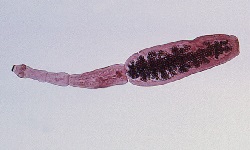
Fasciola hepatica - Introduction, Classification, History, Habitat, Morphology
Introduction of Fasciola hepatica
Fasciola hepatica is the causative agent of human fascioliasis. This parasitic trematode is also known as the common liver fluke or sheep liver fluke. The large liver fluke primarily infects the liver of the sheep while humans are the accidental hosts.
History of Fasciola hepatica
In 1379 de Brie first described Fasciola hepatica which is the first trematode - to be described and its life cycle was also demonstrated - in human history.
Adolph Lultz in 1892 described the mode of infection.
Morphology of Fasciola hepatica
The important morphological features of Fasciola hepatica include adult worms, eggs, and the infective form metacercaria.
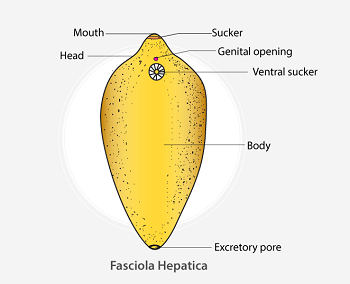
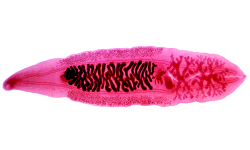
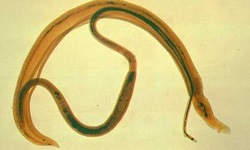
Figure: Fasciola hepatic adult (Source: Byjus)
Adult form
Fasciola hepatica adult form is large, flat, and leaf-shaped brown
measures 2.5 cm to 3 cm in length and 1.5 cm in breadth
the anterior end contains a distinct conical projection and a rounded posterior end
small oral sucker measuring 1mm in diameter is present in a line
posterior cephalic cone broadens to form two shoulders
the alimentary canal is absent – the absence of the anus
hermaphrodite – contains both sexes with well-developed male and female reproductive organs
in sheep, the adult parasite can live for 5 years
in humans, the adult Fasciola hepatica has a lifespan of around 9 years to 13 years
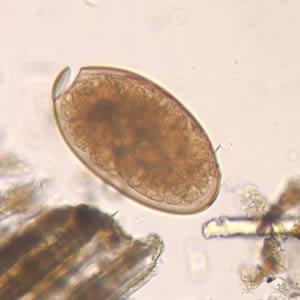
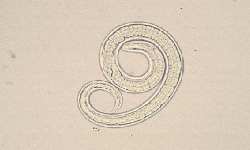
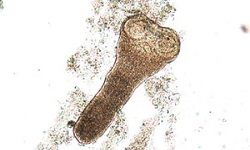
Image: Fasciola hepatic egg (Source: CDC)
Egg
large, ovoid, bile-stained
bile-stained Fasciola hepatica eggs are excreted in the bile into the duodenum
small and distinct operculum
measures 130 μm to 150 μm in length and 63 μm to 90 μm in breadth
unembryonated when freshly passed and further development takes place in the water
contains a large refractile unsegmented ovum surrounded by a mass of yolk cells
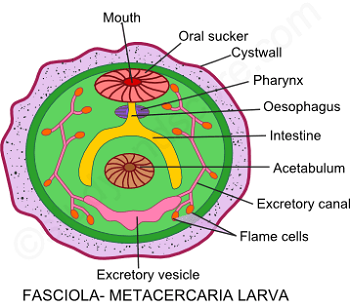
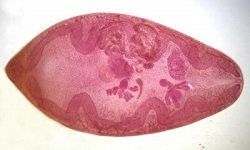
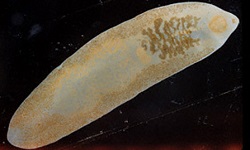
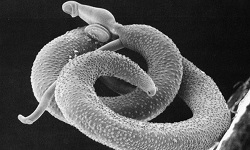
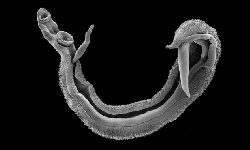
Figure: Fasciola hepatic (Source: )
Infective Form
Metacercaria
Fasciola hepatica metacercaria is the infective form for definitive hosts including humans
found on the surface of watercress and aquatic vegetation
Epidemiology of Fasciola hepatica
Fasciola hepatica is cosmopolitan in distribution – and infection is much more common in countries with massive sheep and cattle populations.
The liver fluke is specific to tropical areas of Southern Asia, Aouth-East Asia, Africa, Europe, and America. Countrywide, it is more common in Bolivia, Ecuador, Egypt, Peru, UK, France, Spain, and Portugal.