Hepatitis A virus - Classification, Morphology, Genome, Properties
Classification of Hepatitis A virus
The classification of Hepatitis A virus is:
Realm: Riboviria
Kingdom: Orthornavirae
Phylum: Pisuviricota
Class: Pisoniviricetes
Order: Picornavirales
Family: Picornaviridae
Genus: Hepatovirus
Species: Hepatovirus A
Morphology of Hepatitis A virus
Hepatovirus A is a small, non-enveloped virus measuring 27 nm in diameter with icosahedral symmetry. Hepatitis A virus has a single-stranded positive-sense liner RNA genome which is approximately 7.5kb. The capsid consists of multiple copies of 3-4 proteins (VP1 to VP4).
Genome of Hepatitis A virus
The viral genome of Hepatitis A virus can be divided into 3 parts:
A 5’ non-coding region (NCR) covalently linked to viral protein Vpg (733 nucleotides)
A short 3’ NCR terminating in a poly (A) tail
A single open reading frame (ORF) that appears to encode all of the viral proteins:
The 5’ region of ORF codes for the major structural proteins of the virus (VP1-VP4)
The 3’ region of ORF encodes a protease, which processes the polyprotein; a polymerase and other functions involved in genome replication
Antigenetically, the Hepatitis A virus (HAV) is highly conserved. It has a single serotype in spite of 4 genotypes differing by around 20% in nucleotide sequence. Most human strains belong to genotypes I or III.
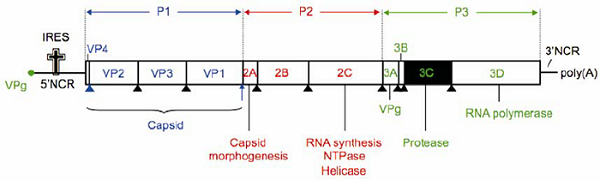
Fig: HAV genome (Source: ResearchGate)
Other properties of Hepatitis A virus
Hepatitis A virus is exceptionally stable
another property of the Hepatitis A virus is, it is ether resistant
stable at pH 3.0
relatively resistant to inactivation by heat (withstands 60°C for 1 hour), lipid solvents such as ether and chloroform, the action of detergents, and drying




.jpg)