Hepatitis B virus - Replication, Transmission
Replication of Hepatitis B virus
Hepatitis B virus replication shows many unique features. At first, the virus shows a well-defined tropism for replication in the liver. Secondly, although a DNA virus, it encodes reverse transcriptase and replicates through RNA intermediates.
The total process involves both the cytoplasm and the nucleus of the cell. The Hepatitis B virus infects hepatocytes. They bind to the host cell receptor, Sodium taurocholate cotransporting polypeptide (NTCP) mediated by HbsAg and are subsequently internalized by receptor-mediated endocytosis and become uncoated.
Inside hepatocytes, the partial DNA strand of the Hepatitis B virus genome is converted to covalently closed circular dsDNA (cccDNA). This genome now is transported to the cell nucleus. cccDNA serves as a template for the transcription of 4 viral mRNAs.
The 4 transcripts undergo additional processing and progenome RNA becomes encapsidated in newly synthesized core proteins. Within the cores, the Hepatitis B virus polymerase synthesis of a negative strand of DNA copy by reverse transcriptase but the positive DNA strand remains incomplete.
These cores then bud from the host membranes acquiring an envelope and exiting the cell. Alternatively, cores may be re-imported into the nucleus and initiate another round of replication in the same cell.
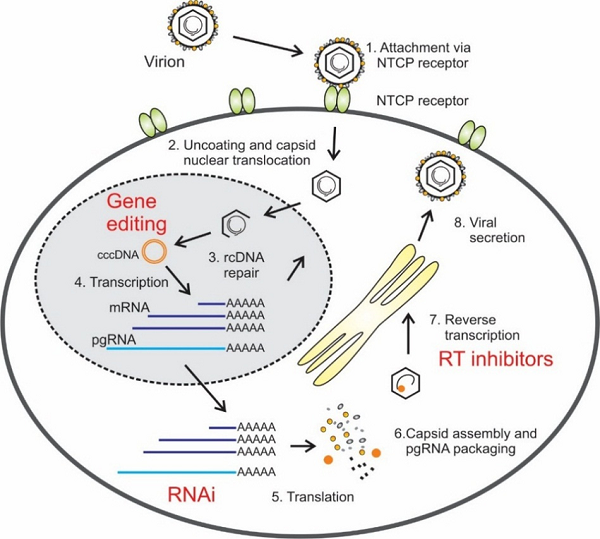
Fig: HBV replication in the host cell (Source: ResearchGate)
Transmission of Hepatitis B virus
The Hepatitis B virus can be transmitted in the following way:
Perinatal transmission
Perinatal transmission of the Hepatitis B virus occurs from mother to child due to contact with the mother’s infected blood during the time of delivery.
Parenteral transmission
Parenteral transmission of the Hepatitis B virus occurs due to transfusion of HBV-infected blood and blood products. Also, intravenous drug users and healthcare workers bear significant risks.
Sexual transmission
Sexual transmission of the Hepatitis B virus of infection occurs between sexual partners.




.jpg)