Paragonimus westermani - Life Cycle, Pathogenesis, Pathology
Life Cyle of Paragonimus westermani
The life cycle of Paragonimus westermani is completed in three hosts- one definitive host and two intermediate hosts.
Definitive host: Humans, Wolf, Fox, Dog, Monkey, Felines (Tiger, Leopard, Lion, Cat)
Intermediate host:
First intermediate host: Freshwater snails belonging to the family Pleuroceridae, Thiaridae – Genera: Semisulcospira, Brotia while Semisulcospira libertina is the optimal intermediate host.
Second intermediate host: Several genera of crab fish including Potamon, Sinopotamon, Parathelphusa, and freshwater crayfish.
* Wild boars, rabbits, and mice are paratenic hosts i.e. intermediate hosts in which parasites do not mature and are not essential to complete their life cycle
the definitive host (including humans) acquires infection after consumption of the second intermediate host several genera of crab fish including Potamon, Sinopotamon, Parathelphusa, and freshwater crayfish – harboring the metacercariae of Paragonimus westermani
after the cyst wall is dissolved in the intestine, larvae are released
larvae penetrate the intestinal wall and reach the peritoneal cavity, remain there for several days, and migrate upwards by piercing through the diaphragm, and both pleural layers, and reach the lungs
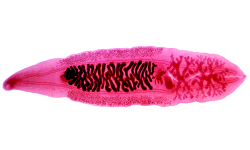
in the lungs, the Paragonimus westermani settle down close to the bronchi where they grow, develop, and sexually mature to become adult flukes
the lung fluke can also migrate to reach other organs and tissues such as striated muscles and the brain
after mating, they began laying unembryonated eggs
the time between infection by metacercariae and the production of eggs i.e. the pre-patent period is around 10 weeks
these eggs are released into the bronchioles from where they are coughed out in the sputum
in cases the sputum is swallowed, the eggs are passed out in the feces
once in the water, further development of Paragonimus westermani eggs takes place
within 2 to 3 weeks, the egg hatches to release one miracidium larva or ciliated larvae per egg
the miracidium larvae of the lung fluke can live for several hours during which it must find and invade the freshwater snails belonging to the family Pleuroceridae, Thiaridae – Genera: Semisulcospira, Brotia while Semisulcospira libertina is the optimal intermediate host
once inside its primary intermediate host, the miracidium larvae underdo asexual reproduction by a single generation of sporocysts, two generations of rediae (mother rediae and daughter rediae)
within 13 weeks, a single miracidium larva gives rise to a large number of cercariae
the mature-free swimming cercariae escape from the snail and swim in the water and might get ingested by the second intermediate host- genera of crab fish including Potamon, Sinopotamon, Parathelphusa, and freshwater crayfish
these cercariae encyst in the second intermediate host to form metacercariae
if uncooked metacercariae harboring a second intermediate host are consumed, humans become infected with Paragonimus westermani and the life cycle continues
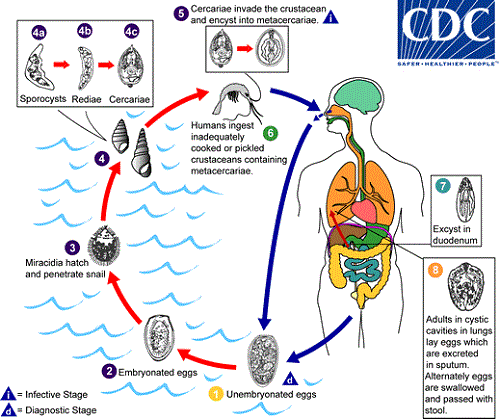
Image: Paragonimus westermani LifeCycle (Source: CDC)
Pathogenesis, Pathology of Paragonimus westermani
Both the eggs and adult Paragonimus westermani are pathogenic to humans while the metacercaria is not pathogenic.
Pathogenesis of adult Paragonimus westermani
in the liver, the adult Paragonimus westermani induces acute inflammation resulting in eosinophilic granulomas as well as multiple small fibrous cysts
in lungs, pathology differs on the basis of a load of flukes and chronicity of infection
* Typically, adult flukes are encapsulated by cysts
* each cyst is usually less than 20 in number
* mostly occur in the right lung
* each cyst contains 2-4 adult Paragonimus westermani
* cyst wall is thick, sclerotic, and containing plasma cells, granulation tissue, lymphoid cells, eosinophils, fibroblasts
* cyst cavity is filled with Charcot-Leyden crystals and eggs
Pathogenesis of Paragonimus westermani eggs
operculated Paragonimus westermani eggs also induce an inflammatory reaction which results in cyst formation
the key pathological feature is the presence of egg-encapsulated cysts in the lung and in some cases, in the brain
these cysts, measuring about 1cm in diameter, are found in deeper layers of the lung
lesion includes thick purulent fluid, a thick layer of blood, and clusters of golden brown Paragonimus westermani eggs
the cysts can rupture as the infection progresses and eggs are led into bronchioles from where they are either expelled with the sputum or the feces if they are swallowed
these cysts may also occur in the liver, mesenteric lymph nodes, peritoneal cavity, intestinal wall, spleen