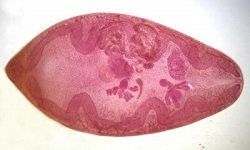
Nectar americanus
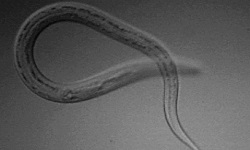
Nectar americanus
The type of helminthiasis caused by the Nectar hookworm is called Necatoriasis.
Ancylostoma duodenale
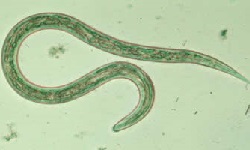
Ancylostoma duodenale
The adult stage of Ancylostoma duodenale habitats in the lumen of the small intestine – commonly in the jejunum, less commonly in the duodenum, and rarely in the ileum.
Kliger’s Iron Agar (KIA)
.jpg)
Kliger’s Iron Agar (KIA)
Kliger’s Iron Agar (KIA) is the media used for the detection of the ability of a microorganism to ferment carbohydrates.
Bile Esculin Test
.jpg)
Bile Esculin Test
Bile Esculin Test is based on the ability of the test microorganism to hydrolyze esculin into glucose and esculetin (6, 7-dihydroxy-coumarin) by the production and action of enzyme esculinase in the presence of bile (4% bile salts or 40% bile).
Beta-Galactosidase Test (ONPG)
.jpg)
Beta-Galactosidase Test (ONPG)
For any organism to utilize lactose, it must be able to synthesize a couple of enzymes – one of which is beta–galactosidase.
Strongyloides stercoralis
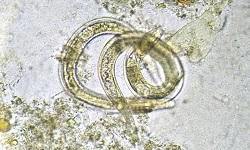
Strongyloides stercoralis
The female Strongyloides stercoralis parasite habitats the mucosa of the small intestine – especially the duodenum and upper jejunum.
Trichuris trichiura
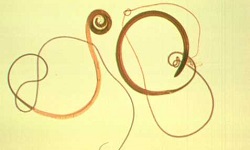
Trichuris trichiura
The name whipworm is derived from its characteristic ship-like shape i.e. it resembles a whip with wider “handles” at its posterior end.
Trichinella spiralis
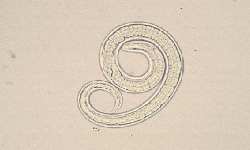
Trichinella spiralis
The parasite is typically present in undercooked pork products and must not be confused with pork tapeworm- which is distantly related.
Clonorchis sinensis
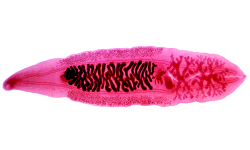
Clonorchis sinensis
Clonorchis sinensis is the causative agent of clonorchiasis, feeds on bile, and is one of the most important liver fluke infecting humans.
Paragonimus westermani