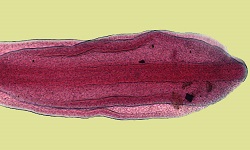
Fasciolopsis buski
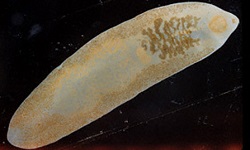
Fasciolopsis buski
Fasciolopsis buski is the most common human intestinal trematode causing infection in man.
Fasciola hepatica
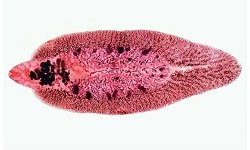
Fasciola hepatica
The large liver fluke primarily infects the liver of the sheep while humans are the accidental hosts.
Schistosoma japonicum
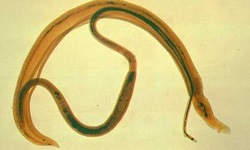
Schistosoma japonicum
The Schistosoma japonicum habitats the mesenteric venules of the small intestine and the rectal (haemorrhoidal) plexus of veins.
Schistosoma mansoni
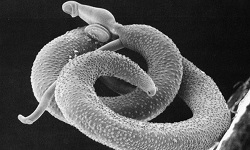
Schistosoma mansoni
Both male and female Schistosoma mansoni are found together in the mesenteric venules which drain the large intestine and posterior part of the ileum (small intestine).
Schistosoma haematobium
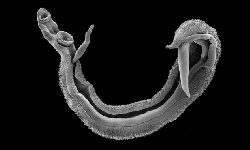
Schistosoma haematobium
Schistosoma haematobium is a parasitic blood fluke and the causative agent of vesical or urinary schistosomiasis.
Hymenolepis nana
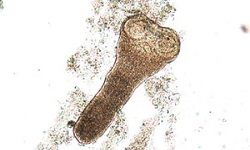
Hymenolepis nana
Hymenolepis nana is the only cestode that does not require an intermediate host.
Echinococcus granulosus
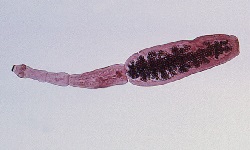
Echinococcus granulosus
The Hydatid cyst of Echinococcus granulosus is the larval stage of this parasite which is highly toxic and antigenic to humans.
Taenia solium

Taenia solium
Pigs acquire the infection after consuming human feces contaminated with the tapeworm egg.
Taenia saginata
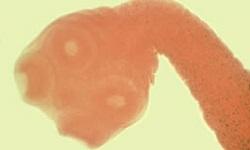
Taenia saginata
Taenia saginata is a large zoonotic tapeworm causing intestinal taeniasis in humans. It is also known as the beef tapeworm.
Diphyllobothrium latum