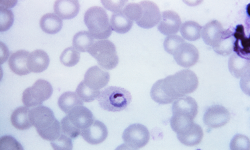
Pneumocystis jirovecii
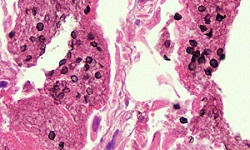
Pneumocystis jirovecii
P. jirovecii is the causative agent of interstitial plasma cell pneumonia
Balantidium coli
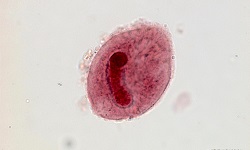
Balantidium coli
Balantidium coli is the only species in the genus Balantidium which is pathogenic to humans.
Sabin-Feldman dye test
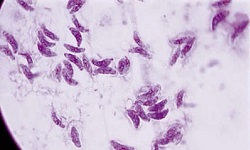
Sabin-Feldman dye test
The sabin-Feldman dye test is used mostly in reference laboratories as a gold standard.
Toxoplasma gondii
Toxoplasma gondii
Merogony occurs in both definitive hosts and intermediate hosts. The sporogony and schizogony take place in the intestine of the definitive host.
Microsporidia
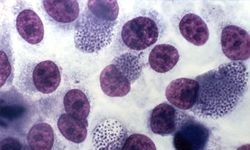
Microsporidia
They have a unique mechanism to infect host cells.
Cystoisospora belli
.png)
Cystoisospora belli
This opportunistic parasitic coccidian is closely related to the genus Cryptosporidium, Cyclospora, and Toxoplasma.
Cyclospora cayetanensis
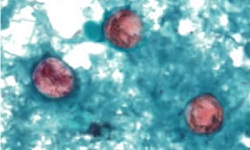
Cyclospora cayetanensis
Cyclospora cayetanensis is the only species of the genus Cyclospora known to cause infection in humans called cyclosporiasis. The parasite, which is coccidian, causes infection of the gastrointestinal (GI) tract.
Cryptosporidium parvum
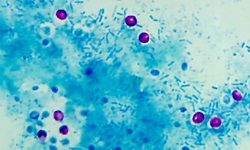
Cryptosporidium parvum
Cryptosporidium parvum is a coccidian parasite that causes infection of the small intestine resulting in diarrhea. Numerous species of Cryptosporidium are known to affect amphibians, fish, birds, and mammals while Cryptosporidium parvum is infectious to human beings.
Babesia
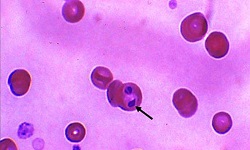
Babesia
Babesia is an intra-erythrocytic protozoan that causes opportunistic infections in humans. They are the causative agents of tick-borne and mainly cause malaria-like illnesses in domestic and wild animals.
Plasmodium ovale