Nectar americanus - Introduction, Classification, History, Habitat, Morphology
Introduction to Nectar americanus
Nectar americanus, also known as the New World hookworm or the American hookworm, is an important etiological agent of hookworm infections in humans. The type of helminthiasis caused by the Nectar hookworm is called Necatoriasis.
Classification of Nectar americanus
Nectar americanus is classified by:
Kingdom: Animalia
Phylum: Nematoda
Class: Chromadorea
Order: Rhabditida
Family: Ancylostomatidae
Genus: Necator
Species: N. americanus
Habitat of Nectar americanus
Nectar americanus, an obligate parasitic nematode, habitats the small intestine of human hosts.
Morphology of Nectar americanus
Compared to the hookworm Ancylostoma duodenale, Nectar americanus is less pathogenic, slightly morphologically smaller, and slender.
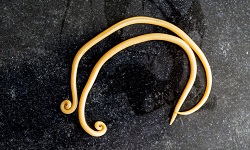
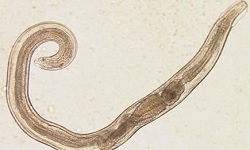
Adult worm
adult worm of Nectar americanus is small and slender
round shaped head
the slight curve at the anterior end in the opposite direction of the body curve, giving the appearance of a hook
transverse cuticular striae is more prominent than in Ancylostoma duodenale
the buccal capsule is small, round, and lined with dorso-median teeth
buccal capsule in males contains 1 pair of chitinous plates on the ventral surface and 1 pair of plates on the dorsal surface
the buccal capsule is 15μm to 16μm in length with a short lumen and thick chitinous wall
between intestine and esophagus, a gap is present
the posterior part of the intestine lacks any refractile body
lifespan range from 3 years to 5 years
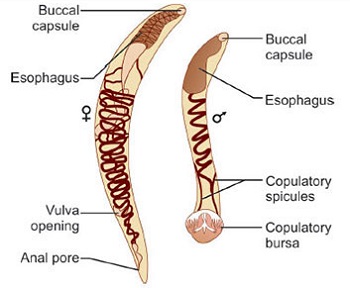
Morphology of adult Nectar americanus (Source: JaypeeDigital)
Male
copulatory organ present in male Nectar americanus
consists of 12 finger-like rays with dorsal rays split from the base
each bifurcation is bipartite
measures 7mm to 9 mm in length
Female
in female Nectar americanus, the vulva is situated in front of the middle of the body
female lack a posterior spine
lays 5,000 to 10,000 eggs/day
measures 9 mm to 11 mm in length
 larva.jpg)
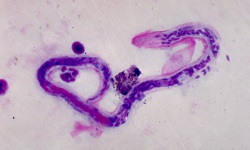
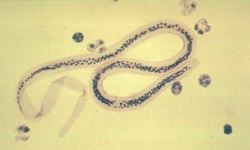
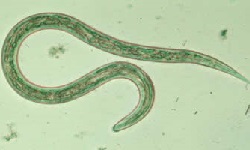
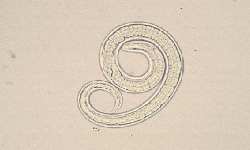
filariform larva of Nectar americanus (Source: ResearGate)
Infective form
Filariform larva
is the infective stage of Nectar americanus
causes infection by penetrating the host skin
third stage larvae (L3)
non-feeding form of the parasite
presence of a striated cuticle and a dark prominent buccal capsule which is absent in Ancylostoma duodenale