Acanthamoeba - Classification, Habitat, Morphology, Culture, History
Introduction of Acanthamoeba
Acanthamoeba is a genus of amoebae that are free-living in soil, dust, sand, rivers, ponds, streams, freshwater, and tap water which are aerobic bacterivores. In certain situations, they can cause infections called acanthamebiasis in humans as well as animals.
The pathogenic species of Acanthamoeba which infect humans include Acanthamoeba culbertsoni, Acanthamoeba castellani, Acanthamoeba polyphage, and Acanthamoeba astronyxis. These amoebae infect:
human central nervous system (CNS) to cause opportunistic granulomatous infections
in healthy individuals, eyes may be infected
in immunocompromised patients, lungs and skin might be infected
Classification of Acanthamoeba
Domain: Eukaryota
Phylum: Amoebozoa
Class: Discosea
Order: Centramoebida
Family: Acanthamoebidae
Genus: Acanthamoeba
History of Acanthamoeba
Culbertson and his team were the first to prove the pathogenicity of Acanthamoeba by infecting lab mice through intra-nasal inoculation which resulted in the production of purulent meningoencephalitis.
Habitat of Acanthamoeba
In humans, Acanthamoeba species inhabit the mouth and the pharynx as commensals. They are also found in the soil, dust, sand, rivers, ponds, streams, freshwater, and tap water.
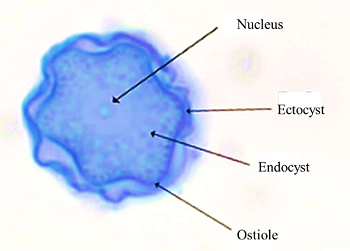
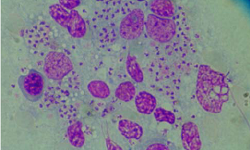
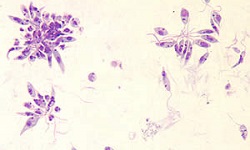
Image: Acanthamoeba morphology (Source: ResearchGate)
Morphology of Acanthamoeba
Acanthamoeba species occur in two morphological stages:
Trophozoite
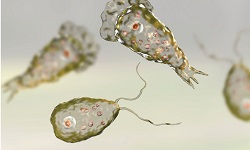
Acanthamoeba trophozoites are large in size: 10-40μm in diameter
variable in shape and size
finely granular cytoplasm contains a single nucleus, mitochondria
the nucleus contains a prominent nucleolus which is large, dense, and surrounded by a halo
the presence of acanthopodia confirms Acanthamoeba trophozoites
acanthopodia are distinctive, slender, spine-like projections of the plasma membrane
Cyst
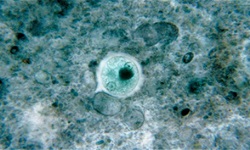
Acanthamoeba cysts measure 15-20 μm in diameter
are variable in size and might be polygonal, spherical, or star-shaped
have a double layered cyst-wall
endocyst (inner wall) is smooth but the shape may be triangular, oval, round, or polygonal and has pores or opercula in numerous points
exocyst (outer wall) is mostly rippled or wrinkled
contains a nucleus located at the center with a clear halo and large dense karyosomes
Culture of Acanthamoeba
In media, Acanthamoeba can be grown:
Non-nutrient agar inoculated with monoxenic culture of bacteria such as Enterobacter species and Escherichia coli
Axenic culture – enriched broth without added bacteria
monolayer cell lines cultures such as Hela cells, MRChuan embryonic lung cells, and monkey kidney cells
grows best at 25° C - 30° C
can encyst both in vitro and in vivo and excysts back to trophozoites when cultured