Cystoisospora belli - Introduction, Classification, Morphology, Epidemiology, Transmission
Introduction of Cystoisospora belli
Cystoisospora belli, previously known as Isospora belli, causes an infection of the gastrointestinal tract called cystoisosporiasis. They mostly cause infection in immune-suppressed human hosts. This opportunistic parasitic coccidian is closely related to the genus Cryptosporidium, Cyclospora, and Toxoplasma.
Classification of Cystoisospora belli
Phenotypically, Cystoisospora belli is classified as:
Kingdom: Chromista
Superphylum: Alveolata
Phylum: Apicomplexa
Class: Conoidasida
Order: Eucoccidiorida
Family: Sarcocystidae
Genus: Cystoisospora
Species: C. belli
History of Cystoisospora belli
Historically, Cystoisospora belli was first described in 1860 by Virchow. The first case of known human infection was described in 1915 among military personnel in World War. This protozoan parasite was named in 1923 by Wenyon.
Habitat of Cystoisospora belli
Cystoisospora belli habitats and infect the epithelial cells of the small intestine and develops in the cell cytoplasm.
In the natural environment, the parasite is cosmopolitan but is mainly found in tropical and subtropical areas of the world such as the Caribbean, Central, and South America, India, Africa, and South East Asia.
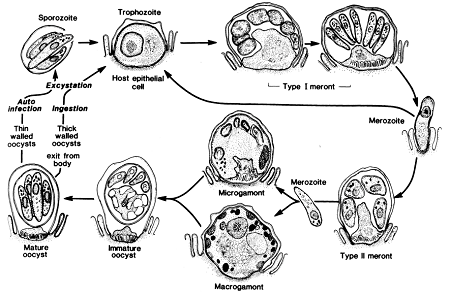
Figure: Cystoisospora belli morphological stages (Source: bio.umass.edu)
Morphology of Cystoisospora belli
Morphologically, Cystoisospora belli exists in the following steps:
Diagnostic form in humans
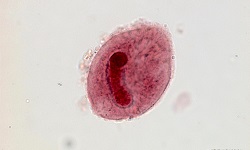
Oocysts
Cystoisospora belli oocysts is found in humans
diagnostic form of Cystoisospora belli
elliptical shape but may vary in shape from long to slender or short
measures 20 μm to 33 μm x 10μm to 19 μm
each oocyst contains two sporoblasts and is surrounded by a two-layered cyst wall
each sporoblast has four sporozoites
these sporozoites are slender, long, and crescent-shaped
sporozoites remain in a cluster of four within the sporocyst wall which also contains granular residual mass
Infective form
Oocyst containing two sporoblasts
the infective form of Cystoisospora belli is an oocyst containing two sporoblasts
immature oocyst are excreted
immature oocysts contain mostly one sporoblast (rarely two)
these oocysts mature outside the host
maturation of oocyst includes the formation of two sporoblasts with each containing four sporozoites
Epidemiology of Cystoisospora belli
Cystoisospora belli is worldwide in distribution but is more common in tropical and subtropical climates.
The infection is endemic to Latin America, Australia, the Caribbean islands, Africa, Southeast Asia, etc.
Reservoir, Source of Cystoisospora belli
Infected hosts are the reservoir/source of infection and no animal reservoir has been found.
Mature oocysts are the infective stages of Cystoisospora belli.
Transmission of Cystoisospora belli
Transmission of Cystoisospora belli occurs through the fecal-oral route- through water or food contaminated with oocysts.