Loa loa - Clinical Manifestation, Complications, Prognosis
Clinical Manifestation of Loa loa
In most cases, Loa loa infection (loiasis) is asymptomatic and one-third of patients are amicrofilaremic.
In symptomatic cases, which appear months to more than a decade after infection, clinical manifestations include skin and ocular lesions. Dying adult worms cal also causes chronic abscesses resulting in the formation of granulomatous reactions and fibrosis.
The parasites may also reside in the testes, kidneys, heart, penis, nipples, bridge of the nose, etc.
Skin lesions
Skin lesions due to Loa loa infection include fugitive swelling or Calabar swelling.
Calabar swelling
Calabar swelling is the transient migratory swelling of the localised sub-cutaneous host tissue
caused due to migration of adult worms
itching and localized pain for several hours is followed by the onset of swelling
swelling measures 3 to 10 cm in diameter, non-erythematous and lats for a few days to weeks
mostly affected areas include knee joints or wrist joints
the parasites are not present in the swellings but rather below the surface of the skin
associated with pruritus (itching) and urticaria (skin eruptions)
in chronic cases, cyst-like enlargements of the connective tissue around the sheaths of muscle tendons can take place
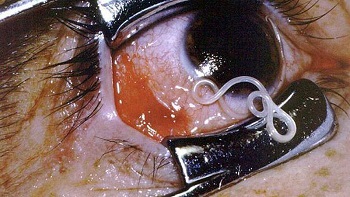
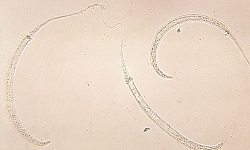
ocular Loa loa infection (Source: Drug and Diagnostics for Tropical Diseases)
Ocular lesions
Ocular lesions caused by Loa loa infection can be clinically classified into three types:
Conjunctival granuloma
Oedema of the eyelid
Proptosis
Conjunctival granuloma
conjunctival granuloma due to Loa loa infection is caused by the migration of adult worms in the subconjunctival tissue
may present as single or multiple small nodules measuring about 2mm in diameter
found in deeper layers of the conjunctiva and close to the scleral tissue
painless but may be itchy
Oedema of the eyelid
oedema of the eyelid is a painless condition
accompanied by itching
no other clinical syndromes have been noted
Proptosis
proptosis is known as ‘bug-eye’ or ‘bulge-eye’
caused by oedema of the orbital cellular tissue
rapidly onset
painless condition
associated with itching
Complications of Loa loa
The complication of Loa loa includes retinopathy, arthritis, endomyocardial fibrosis, fugitive swellings, retinopathy, and neuropathy.
A severe and often fatal complication of Loa loa infection is meningoencephalopathy. This condition can occur spontaneously or after treatment with diethylcarbamazine (DEC) in patients with high levels of microfilariae.
Prognosis of Loa loa
The prognosis of Loa loa infection is good if treated early.
.jpg)