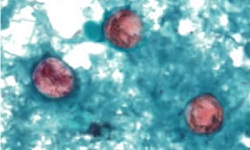
Diphyllobothrium latum - Life Cycle, Pathogenesis, Pathology, Host Immunity, Clinical Manifestation
Life Cycle of Diphyllobothrium latum
Diphyllobothrium latum is the only tapeworm with a life cycle in the water. Also, it is the only pseudophyllidean cestode whose definitive host is the man and needs two intermediate hosts.
The life cycle of the Diphyllobothrium latum parasite completes in both the definitive host and intermediate host.
Definitive host: Humans and other freshwater fish-eating animals such as bears, wolves, cats, foxes, leopards, dogs, etc are definitive hosts of Diphyllobothrium latum.
Intermediate host: It requires two intermediate hosts to complete its life cycle.
First intermediate host: freshwater copepods such as Diaptomus gracilis, Diaptomus graciloides, Cyclops furcifer, and Cyclops strennus.
Infection of Diphyllobothrium latum in humans begins with the consumption of raw or partially cooked fish infested with plerocercoid larvae
inside the human host, the plerocercoid larvae attach to the small wall intestine
within 5 weeks to 6 weeks, the larvae develop and mature into adult
adult tapeworm begins to lay unembryonated eggs which are discharged into the intestine and passed along with the feces
these eggs develop only once it reaches freshwater lakes, rivers, or reservoirs
depending upon the temperature of the water, Diphyllobothrium latum eggs develop in 8 to 14 days which hatches to release coracidium
*coracidium (first-stage larvae) are spherical ciliated embryos containing three pairs of hooklets
if a coracidium is ingested by a freshwater crustacean of the genus Diaptomus or Cyclops, it loses its cilia and penetrates through the first intermediate hosts intestine to reach the hemocoel
in the hemocoel (body cavity), they transform into tiny worm-like tailed second-stage larvae called procercoid, measuring at around 0.5mm
if small freshwater fish ingest the copepods harboring procercoid, the parasite is freed into the fish intestine
within a few hours of infestation, the procercoid migrates into the fish muscles, liver, and fat the fish
in these tissues within 1 week to 3 weeks, it develops into plerocercoid- the third stage larvae of Diphyllobothrium latum
even though these small freshwater fishes are rarely consumed by humans, large predatory fish such as pike, and salmon do consume them
inside these predatory fish, the plerocercoid does not undergo further development but remains viable
when humans or other mammals consume raw large predatory fish harboring plerocercoid larvae, they become infected and the life cycle of Diphyllobothrium latum is continued
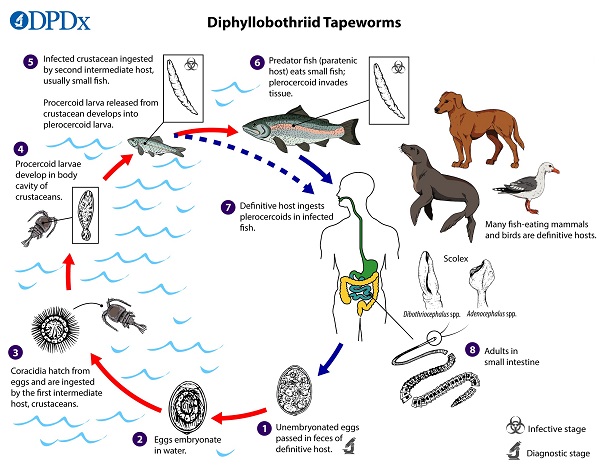
Figure: D. latum lifecycle (Source: CDC)
Pathogenesis, Pathology of Diphyllobothrium latum
Diphyllobothrium latum infection is associated with pernicious anemia whose pathogenesis involves:
reduced secretions of intrinsic factor
low dietary intake of vitamin B12
since adult Diphyllobothrium latum has an extra-ordinary affinity for vitamin B12, the tapeworm absorbs the vitamin B12 in the stomach
* the parasite lies in close proximity to the stomach and blocks the absorption of vitamin B12
As vitamin B12 is essential for the development of erythrocytes, its deficiency due to the tapeworm causes pernicious anemia.
Host Immunity of Diphyllobothrium latum
There is little to no host immunity against Diphyllobothrium latum parasite during the infection. Thus, high rates of re-infection and superinfection by the parasite can occur.
Clinical Manifestation of Diphyllobothrium latum
The pre-patent period of Diphyllobothrium latum is 4 weeks to 6 weeks. Most humans are infected with a single parasite and most cases are symptomatic.
In cases where symptoms are visible, clinical syndromes include:
abdominal discomfort
diarrhea
vomiting
weight loss
numbness of fingers and toes
dizziness

.png)