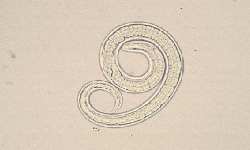
Strongyloides stercoralis - ewkrkjwer
Complications of Strongyloides stercoralis
Complications of Strongyloides stercoralis include malabsorption, intestinal perforation, haemorrhage, asthma, pneumonitis, and pleural effusion. Severe complications include meningitis, brain abscess and gram-negative septicemia.
Prognosis of Strongyloides stercoralis
The prognosis of Strongyloides stercoralis infection is good in the immunocompetent host in cases of both acute strongyloidiasis and chronic strongyloidiasis.
In cases of hyperinfection syndrome and disseminated strongyloidiasis, the prognosis is poor even with anthelmintics and supportive treatment. The mortality rate is up to 60%.
Epidemiology of Strongyloides stercoralis
Epidemiological studies have concluded that Strongyloides stercoralis is worldwide in distribution.
This parasitic infection is endemic to the tropics and subtropics such as West Africa, South America, Brazi, and South-East Asia.
Reservoir, Source of Strongyloides stercoralis
Moist soil contaminated with human faeces is the main source of infection for Strongyloides stercoralis. Infected man is the reservoir for the parasite while animals such as dogs and cats are also the reservoir.
Transmission of Strongyloides stercoralis
The transmission of Strongyloides stercoralis occurs via the following routes:
penetration of the host skin by the filariform larvae
transmission of larvae from mother to infant through milk i.e. trans mammary transmission has been seen but is less common
ingestion of food and drink contaminated with Strongyloides stercoralis larvae
via organ transplant from the infected to the recipient
Treatment of Strongyloides stercoralis
The treatment of Strongyloides stercoralis is done by use of several anthelmintics including ivermectin, albendazole, and mebendazole.
Even asymptomatic cases need to be treated for infection. Moreover, therapy with corticosteroids is not done since hyperinfection and death might occur.
Prevention, Control of Strongyloides stercoralis
The prevention and control of Strongyloides stercoralis are achieved by:
immediate treatment of infected people/animals to contain the reservoirs
reduce contamination of water sources by human faeces i.e. proper sewage disposal
proper washing of food that is consumed raw such as salads
boiling and/or filtration of drinking water
not using human faeces as a source of fertilizer
improvement of personal hygiene