Trypanosoma cruzi - Clinical Manifestations, Epidemiology, Transmission, Reservoir, Source
Clinical Manifestations of Trypanosoma cruzi
The clinical manifestations caused by Trypanosoma cruzi include acute Chagas’ disease, chronic Chagas’ disease, and latent asymptomatic type (chronic indeterminate form).
Acute Chagas’ disease
Acute Chagas’ disease mostly occurs in infants and children
the incubation period of around 1 week
at the site of inoculation, localized edema and erythema known as Chagoma is seen
Chagoma is also accomplished by local lymphadenopathy
in cases of infection of the conjunctiva of the eye, unilateral painless edema of the palpebral and periocular tissue develops called Romana’s sign
Romana’s sign may also occur on the skin
associated with fever, malaise, edema of the face as well as extremities, generalized lymphadenopathy, moderate hepatosplenomegaly
in severe cases, myocarditis may occur
this acute stage might last for 20-30 days
in most cases, the infection caused by Trypanosoma cruzi, may resolve spontaneously while some enter into an asymptomatic or indeterminate stage
Chronic Chagas’ disease
Chronic Chagas’ disease mainly occurs in children and adults of age 20 years to 40 years
common in individuals with a history of acute Chagas’ disease
as the heart is most commonly involved, progressive development of cardiopathy with electro-cardiographic anomalies is seen
in addition, the complete right bundle branch block and atrioventricular block of varying degrees have been recorded
sudden heart failure may result in the death
in other cases of Trypanosoma cruzi infection, megacolon and megaoesophagus might take place
individuals with megacolon suffer from abdominal pain as well as chronic constipation
patients with megaesophagus may present with dysphagia, odynophagia, and regurgitation
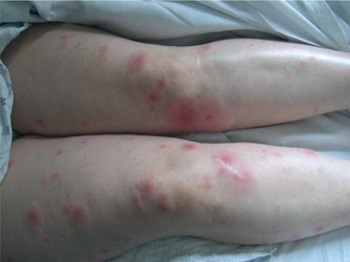
Image: Trypanosoma cruzi cutaneous manifestation (Source: europepmc)
Complications
Some important complications of Trypanosoma cruzi, in acute cases, include myocarditis and meningoencephalitis which may result in the death of infected children or newborns
in cases of chronic Chagas’ disease, complications such as cardiomyopathy, chronic esophagopathy, and chronic colopathy may arise
in HIV patients with Chagas’ disease, myocarditis and meningoencephalitis are important causes of death
Prognosis of Trypanosoma cruzi
in chronic cardiomyopathy, the prognosis is poor with sudden death in 60% of cases
Death is mostly due to ventricular fibrillation while apical aneurysm, thromboembolism, and cognitive heart failure are other causes
in cases where Trypanosoma cruzi has undergone an asymptomatic or indeterminate stage, the prognosis is excellent with patients surviving ten or more years after diagnosis
Epidemiology of Trypanosoma cruzi
Epidemiologically, Chagas’ disease is a major health problem in 18 Latin American countries including Brazil, Argentina, Paraguay, Honduras, El Salvador, Venezuela, Ecuador, Chili, Uruguay, Mexico, and Nicaragua.
Trypanosoma cruzi is absent in Africa, Asia, and Australia.
Reservoir, Source of Trypanosoma cruzi
The reservoir of Trypanosoma cruzi are dogs, rabbits, and bugs in cases of domestic infection while small mammals such as rodents, marsupials, and sylvatic reduviid bugs are reservoirs of Trypanosoma cruzi in the Sylvatic cycle.
All the reduviid bugs belong to Triatoma spp.
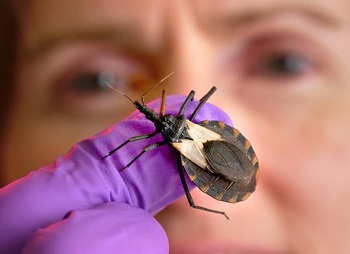
Image: Triatoma pallidipennis - vector of Trypanosoma cruzi (Source: American Society of Microbiology)
Transmission of Trypanosoma cruzi
The transmission of Trypanosoma cruzi takes place via two cycles:
Domestic cycle
transmission of Trypanosoma cruzi takes place between a man and domestic animals with reduviid bugs as the parasite vector
the three most important vector species include Triatoma infestans, Triatoma dimidiata, and Rhodnius prolixus
common in rural areas with poor sanitation and low socio-economic condition
Sylvatic cycle
transmission of Trypanosoma cruzi takes place between small mammals such as rodents, marsupials, and sylvatic reduviid bugs which are reservoirs of Trypanosoma cruzi in man
Transmission of Trypanosoma cruzi takes place in the following ways:
during the bite by reduviid bugs (80% of human infections)
blood transfusion (5%-20% of cases)
congenital infection – can occur in both acute and chronic cases (2%-10% of cases)
laboratory inoculation – accidental inoculation
oral transmission – mostly in Amazon due to consumption of food with feces contaminated with Trypanosoma cruzi