Balantidium coli - Life Cycle, Pathogenesis, Pathology, Clinical Manifestation, Complication, Prognosis
Life Cycle of Balantidium coli
The life cycle of Balantidium coli is completed in a single host- in pigs while humans are accidental hosts.
Man acquires Balantidium coli infection by ingestion of water, food contaminated with infective cysts
cysts then excysts in the small intestine
the parasite then travels to the large intestine, caecum, and terminal ileum where they multiply
each cyst only produces one trophozoite which may remain in the intestinal lumen or invade the submucosa of the large intestine
these Balantidium coli trophozoites undergo asexual reproduction by binary fission resulting in the production of two daughter trophozoites
the process of binary fission involves the division of the micronucleus followed by the division of the macronucleus and finally the cytoplasm
the binary fission repeats several times to produce a large number of trophozoites
trophozoites may also undergo syngamy i.e. sexual reproduction by conjugation
the process of conjugation involves two trophozoites coming in contact with each other and exchanging nuclear material between them after which they detach
the trophozoites after a certain period of time and multiplication eventually encyst to form Balantidium coli cysts
these cysts are passed out in the feces and if trophozoites are passed out along with the feces, cannot encyst and disintegrate
mature cysts are infectious to man and if ingested by a susceptible human host, the Balantidium coli life cycle is repeated
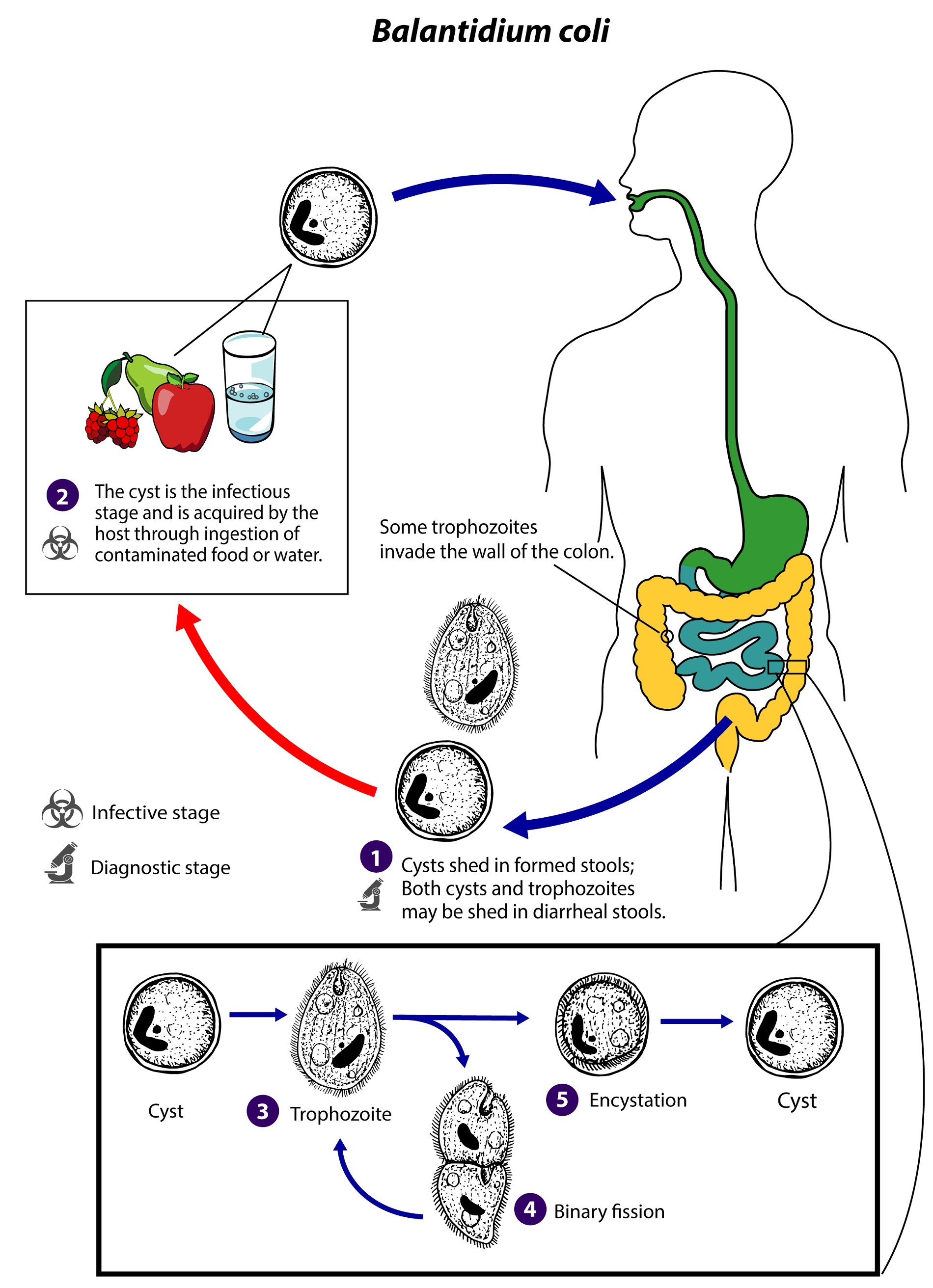
Figure: Balantidium coli life cycle (Source: CDC)
Pathogenesis, Pathology of Balantidium coli
Balantidium coli can be found in the lumen of the host colon – both as a trophozoite and a cyst. The pathology of the parasite involves the invasion of the intestinal mucosa and submucosa which causes ulcers known as Balantidium ulcers.
The invasion by the protozoa parasite is facilitated by
the mechanical action of ciliary movement of the trophozoites
hyaluronidase produced by the parasite
Balantidium ulcers do not invade the muscular layer of the intestine, unlike amoebic ulcers. The parasites do not invade the liver or any other extra-intestinal tissues or organs. Perforation is an important complication of Balantidium coli infection.
Host Immunity of Balantidium coli
The function and response of host immunity in humans – humoral or cell-mediated – is not known.
Clinical Manifestations of Balantidium coli
Balantidium coli is the causative agent of balantidiasis or ciliate dysentery, which is the most common clinical manifestation. Most infections are asymptomatic or self-limiting.
Ciliate dysentery
Mild infection
In cases of mild infections, symptoms include intermittent diarrhea alternating with constipation.
Acute infection
in acute cases, diarrhea is accompanied by blood and mucus (ciliate dysentery)
other symptoms include fever with gastrointestinal symptoms such as nausea, vomiting, intestinal colic, severe abdominal pain
in rare cases, an acute infection may lead to fulminant ulceration with perforation of the intestine, hemorrhage, shock, and even death
Chronic infection
in cases of chronic infections, symptoms include intermittent diarrhea alternating with constipation
the diarrhea stool contains mucus but rarely any blood
parasites are mostly absent in the stool
Balantidium ulcers
they are similar to that ulcers formed by intestinal amoebiasis
occurs in the caecum, rectum, ascending colon, sigmoid colon, etc
these ulcers are oval or round with undermined edges
the floor of the ulcer is filled with necrotic materials, and pus and the trophozoites are found in the pus and at the edge of the ulcer
host immune cells such as polymorphonuclear cells, lymphocytes, and eosinophils are also found in the ulcer
Complications of Balantidium coli
The complication of Balantidium coli infection is intestinal perforation while extra-intestinal infections are rare.
Prognosis of Balantidium coli
In otherwise healthy individuals, the prognosis is excellent. In fact, recovery occurs without any treatment.
In immunocompromised and malnourished individuals, Balantidium coli infection can be fulminant.

.png)