Brugia malayi - Introduction, Classification, History, Habitat, Morphology
Introduction to Brugia malayi
The filarial nematode Brugia malayi is is arthropod-borne parasite causing Malayan lymphatic filariasis (also known as elephantiasis) in humans. It is one of the three causative agents of lymphatic filariasis, Wuchereria bancrofti and Brugia timori being the other two. Elephantiasis is characterized by swelling of the lower limbs.
Classification of Brugia malayi
The classification of Brugia malayi is as follows:
Kingdom: Animalia
Phylum: Nematoda
Class: Chromadorea
Order: Rhabditida
Family: Onchocercidae
Genus: Brugia
Species: B. malayi
History of Brugia malayi
Lichtenstein was the first person to describe microfilariae of Brugia malayi in the peripheral blood of a man from Sumatra, Indonesia.
Dutch parasitologist Steffen Lambert Brug described the parasite in 1927 as a new species as it differed physiologically and morphologically from the filarial roundworm Wuchereria bancrofti. However, only when Rao and Mapelstone identified two adult Brugia malayi worms in India in the 1940s, was Lichtenstein and Brug's hypothesis accepted.
Habitat of Brugia malayi
Adult Brugia malayi habitats the lymphatic vessels – especially the lymph nodes of humans as well as other mammals. Meanwhile, microfilariae of Brugia malayi are found in the peripheral blood circulation.
Morphology of Brugia malayi
The significant morphological features of Brugia malayi include the adult worm, microfilaria, and infective larva.
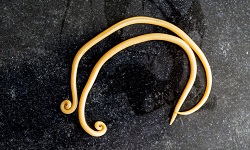
Adult worm
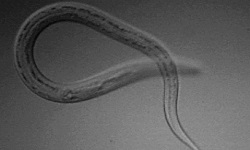
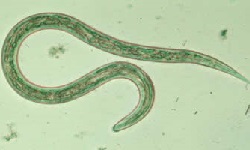
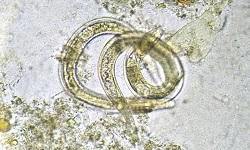
adult worms of Brugia malayi are morphologically similar to Wuchereria bancrofti but smaller in comparison
resembles typical nematode roundworms
moves in an S-shaped motion
has only longitudinal muscles
female adult worms measure 50mm in length while the male Brugia malayi adult measures 25mm in length
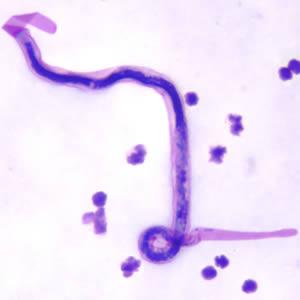
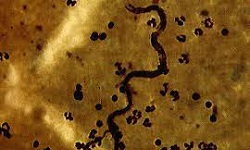
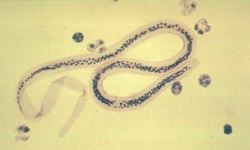
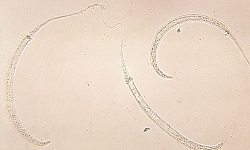
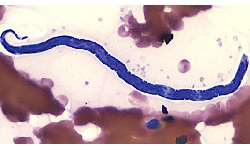
Brugia malayi microfilaria (Source: CDC)
Microfilariae
Brugia malayi microfilariae measure 200–275 µm in length and 5 to 6 µm in diameter
are sheathed which stains heavily with Giemsa statin
sheath, which is a thin layered eggshell, surrounds the microfilariae in the host bloodstream
the sheath remains with the parasite until they are digested in the vector (mosquito) midgut
present in the peripheral blood
colorless and transparent with pointed tails and blunt heads
presence of a noncontinuous row of nuclei in the tip of the tail with two separated and distinguished nuclei
* This differentiates it from Wuchereria bancrofti microfilariae (has no nuclei) and Loa loa microfilariae (has a continuous row of nuclei in the tail)
Brugia malayi microfilariae have a cephalic space ratio of 2:1
has two variants – nocturnal periodic and sub-periodic
nocturnal periodicity i.e. present in peripheral blood at night (between 10 pm to 4 am) is more common, transmission occurs by Anopheles and Mansonia mosquitoes
sub-periodic are less common, are zoonotic, and are transmitted by Mansonia mosquitoes
Infective form
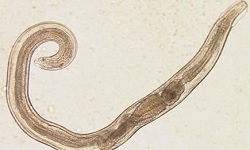
The infective form of Brugia malayi is the third-stage larvae (L3).
Third-stage larvae (L3)
third stage larvae (L3) are found in the mosquito such as Mansonia, Anopheles, and Aedes mosquitoes
elongated, filariform
measure 1500 µm to 1800 µm in length, 18 to 23 µm in breadth
.jpg)