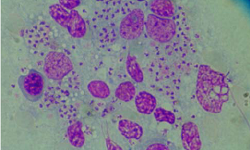
Plasmodium malariae - Host Immunity, Clinical Manifestation, Complications, Epidemiology, Reservoir, Transmission
Host Immunity of Plasmodium malariae
As Plasmodium malariae is able to evade the host immune system by possibly changing its surface antigen, its erythrocytic forms are able to persist for a longer period of time.
Clinical Manifestation of Plasmodium malariae
Plasmodium malariae is the causative agent of quartan malaria.
Severe cases of Plasmodium malariae are rare
the incubation period ranges from 18 days to 40 days
most infected individuals are asymptomatic for a longer period of time than other malaria species
the malarial fever occurs every 72 hours (quartan malaria)
fever occurs when mature erythrocytic schizonts rupture to release merozoites
in the early stage of Plasmodium malariae infection, the spleen is enlarged
Although typical periodicity of fever is absent in initial infection of Plasmodium malariae, long-standing synchronous infections are most likely to present with a classical periodicity of fever
Complications of Plasmodium malariae
Recrudescence
recrudescence is a charactesrstic fecture of quartan malaria
due to the small number of viable merozoites inside the RBC of the internal organs, the infection may persist for many years
able to evade the host immune system by possibly changing their surface antigen, their erythrocytic forms are able to persist for a longer period of time
recrudescence of quartan malaria may last for up to 40 years after the initial infection
Nephrotic syndromes
a serious complication of Plasmodium malariae infection
frequently seen in children
in untreated cases of Plasmodium malariae infection, the disease may progress to kidney failure
edema, proteinuria, and low level of serum albumin are other clinical symptoms
caused by deposition of the antibody-antigen complex in the glomeruli of the kidney
not usually treatable by antimalarials, steroids, and cytotoxic drugs
Prognosis of Plasmodium malariae
In uncomplicated cases, the prognosis of malaria is good with antimalarial drugs.
Epidemiology of Plasmodium malariae
Plasmodium malariae is endemic to tropical and sub-tropical countries. They can be found in Africa, New Guinea, Burma, Sri Lanka, Malaysia, Europe, Indonesia, Brazil, Panama, Guyana, and the USA.
Reservoir, Source of Plasmodium malariae
Man and chimpanzees are the source of Plasmodium malariae. Individuals suffering from acute malaria and chronic malaria harboring gametocytes are reservoirs of the malaria parasite.
Natural vectors include the female hematophagous Anopheles mosquitoes.
Transmission of Plasmodium malariae
Plasmodium malariae malaria is transmitted by:
bite of infected female anopheles mosquito during blood meal – the sporozoites are transmitted
blood transfusion from patients suffering from parasitemia but lacking typical malaria symptoms such as fever – the merozoites are transmitted
organ transplantation
.png)