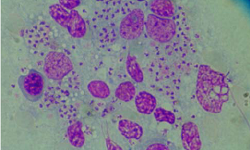
Plasmodium malariae - Introduction, Classification, History, Habitat, Morphology, Culture
Introduction of Plasmodium malariae
The genus Plasmodium causes the vector-borne disease malaria. These parasites show an alternation of generation accompanied by an alternation of hosts. In the human host, the asexual cycle (schizogony) takes place inside the erythrocytes while the sexual cycle (sporogony) takes place in the mosquito host.
Typically, the infected erythrocytes produce pigments that are visualized by light microscopy.
Plasmodium vivax, P. ovale, and P. malariae belong to the subgenera Plasmodium while P. falciparum belongs to the subgenus Laverania.
Plasmodium malariae is the causative agent malariae malaria or quartan malaria.
Classification of Plasmodium malariae
Kingdom: Chromista
Subkingdom: Harosa
Infrakingdom: Halvaria
Superphylum: Alveolata
Phylum: Apicomplexa
Class: Aconoidasida
Order: Haemospororida
Family: Plasmodiidae
Genus: Plasmodium
Species: P. malariae
History of Plasmodium malariae
Plasmodium malariae is the parasite of chimpanzees and was previously named Plasmodium rodhaini.
Habitat of Plasmodium malariae
In the mammal host, Plasmodium malariae infects only old erythrocytes.
Morphology of Plasmodium malariae
The various morphological forms of Plasmodium malariae depend on the host the parasite is residing in i.e. the diagnostic form or the infective form.
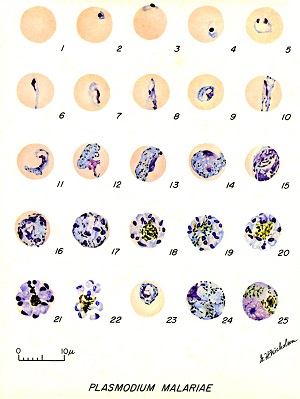
Figure: Development of the erythrocytic stages of Plasmodium malariae. 1, normal red cell; 2 to 5, young trophozoites; 6 to 11, growing trophozoites; 12 and 13, nearly mature and mature trophozoites, respectively; 14 to 20, developing schizonts; 21 and 22, mature schizonts; 23, developing gametocyte; 24, mature macrogametocyte; 25, mature microgametocyte (Source: journals.asm.org)
Diagnostic forms in humans
The diagnostic forms of Plasmodium malariae found in the human host include
Early trophozoite (ring form)
Late trophozoite (trophozoite form)
Schizont
Gametocytes
Early trophozoite (ring form)
are relatively large and occur in peripheral blood
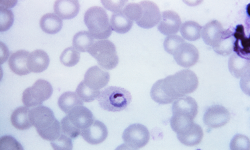
have a delicate blue-stained ring of cytoplasm with a red chromatin dot
in some cases, two red chromatin dots can be found separated or closed together
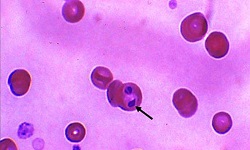
sometimes, two early trophozoites can be found in a single infected RBC
the cytoplasm of Plasmodium malariae stains deep blue than P. vivax
also, the cytoplasm of Plasmodium malariae is smaller, thicker, and heavier than that of P. vivax
Late trophozoite (trophozoite form)
are large but lack amoeboid form
smaller than P. vivax
consists of abundant chromatin, yellow-brown coarse pigment granules, and an inconspicuous vacuole which is characteristic
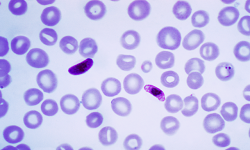
show characteristic band form (ribbon-like) and stretch directly across the infected erythrocytes
Schizont
young schizonts are small and compact with few chromatin masses and coarse pigments
mature schizont contains around 6 to 12 merozoites
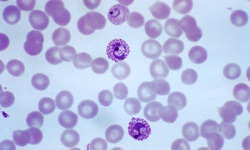
merozoites are arranged typically in the form of ‘rosettes’ or ‘daisy-head’ pattern
found in peripheral blood
mature schizonts almost fill their host cells
Gametocytes
There are two types of gametocytes- macrogametocytes, and microgametocytes. Immature gametocytes are found in the peripheral blood.
Macrogametocytes
smaller than P. vivax
they are round or oval, compact, and filled with enlarged erythrocytes
smaller nucleus with a compact mass of chromatin
the fine granules are arranged in small masses and occur near the periphery of P. vivax
the cytoplasm stains blue while chromatin pigments deep red and violet
Microgametocytes
smaller than macrogametocytes
oval or round with a large nucleus
chromatin granules are arranged to form a spindle
cytoplasm, which is dark blue, contains dark, coarse hemozoin pigments distributed throughout the cytoplasm
do not occupy the entire host RBC
Infective form
The infective form of Plasmodium malariae for humans is the sporozoites.
Sporozoites
measures 13μm to 14μm
thicker and coarser than other Plasmodium species infecting man
Culture of Plasmodium malariae
The culture of Plasmodium malariae is still in the experimental stage. Studies have been conducted to culture Plasmodium malariae in mixed culture with P. falciparum.
.png)