Babesia - Clinical Manifestation, Complications, Prognosis, Epidemiology, Reservoir, Transmission
Clinical Manifestation of Babesia
In otherwise healthy hosts, the clinical manifestation of Babesia includes acute infections resembling malaria.
In individuals who are elderly, immunocompromised, or have undergone splenectomy, babesiosis is more fulminant with the prolonged clinical course which might turn fatal.
The level of parasitemia is less than 10% in individuals with intact spleen while in asplenic patients, the level of parasitemia may vastly range from 1% to 90% depending upon several conditions.
Babesia bovis infection
Babesia bovis infections are severe, fulminant, and may be fatal
occurs mainly in immunocompromised and splenectomized individuals
misdiagnosed with Plasmodium falciparum infection expect the absence of cerebral manifestations
prevalent in Europe and occurs mainly in cattle
syndromes include fever, prostration, jaundice, anemia, hemoglobinuria
Babesia microti infection
Babesia microti infection occurs in North America
reservoir is rodent
infection can occur in people with intact spleen and people older than 50 years
the incubation period is 1-3 weeks
may manifest as mild or sub-clinical
insidious in people with Hiv, elderly, preexistent disease, or have undergone splenectomy
mostly limiting and rarely fatal
syndromes include fever, hepatosplenomegaly, moderate to severe anemia
Complications of Babesia
Complications of Babesia are:
Nearly 25% of individuals infected with Babesia spp are co-infected with Lyme disease (the etiological agent is Borrelia burgdorferi)
conditions such as endotoxemia, complement activation, microemboli, cytoadherence, and disseminated intravascular coagulation may result in Acute respiratory distress syndrome (ARDS)
ARDS is a common complication of asplenic patients
in severe cases, pulmonary edema and respiratory failure occur
in post-splenectomy patients, generalized seizures, acute renal failure, and haemophagocytic syndromes may occur
Prognosis of Babesia
In otherwise healthy individuals with intact spleen, the prognosis of Babesia is good while in asplenic patients, the infection may turn fatal.
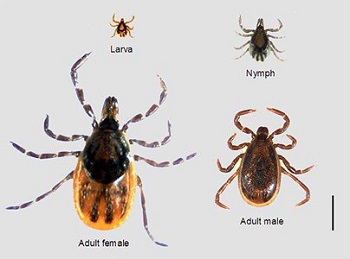
Image: Babesia spp vector is the tick (Source: Live Science)
Epidemiology of Babesia
Babesia spp, which causes babesiosis, is a zoonotic infection transmitted to humans from wild and domestic animals through the bite of a tick vector.
Epidemiologically, babesiosis occurs in Europe and Asia, and infections are mostly caused by Babesia microti.
Babesia microti is found in the USA while Babesia divergens and Babesia bovis are found in European countries such as France, Ireland, and Scotland, and Salviac states like Russia and Yugoslavia.
Reservoir, Source of Babesia
Domestic and wild animals are an important source and reservoir of Babesia spp infection. Man is an accidental host.
Animal reservoirs are hard tick vectors of the genus Ixodes, Boophilus, and Dermacentor. All stages of the parasite- larvae, nymph, and adult tick- can infect a human.
Transmission of Babesia
Babesia is transmitted from animal reservoirs to humans by the bite of hard tick vectors of the genus Ixodes, Boophilus, and Dermacentor. All stages of the parasite- larvae, nymph, and adult tick- can infect a human.
The parasite is rarely transmitted by blood transfusion and transplacental/perinatal route.

.png)